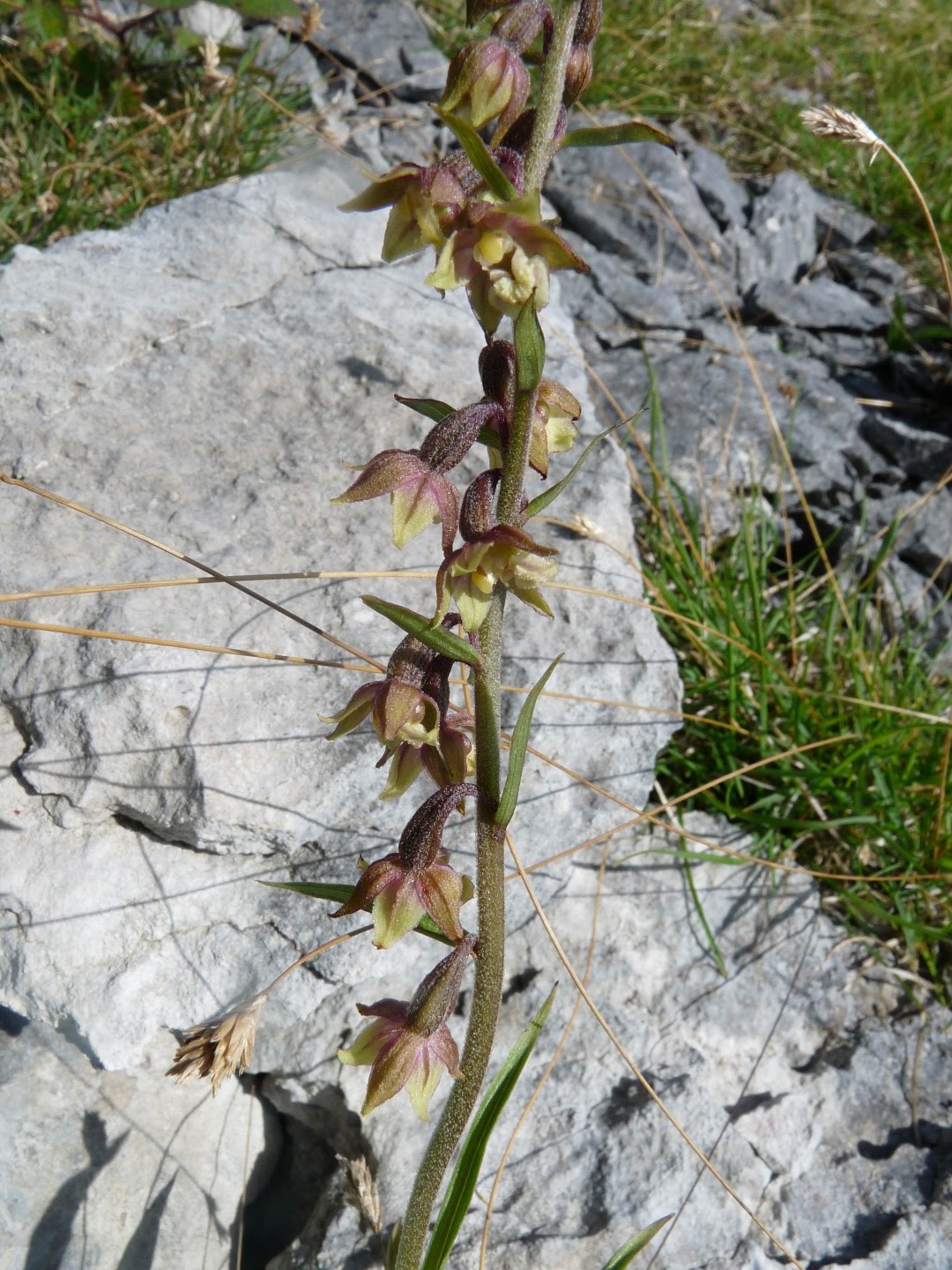
Sunday 20th August 2017 - Studies of "denticulation" profiles
I have been doing some leaf edge profiling (denticulation samples) on some of the 17s plus others. So far it has been very interesting although the outcome is very similar to my sneak previews with my 20x glass. These are some of the results after checking through at 40x. The two large E,. Helleborines which are just in front of the 17 area and lie within spitting distance to most of the "17" hybrids are showing at 100% true E.Helliborine profile as you would expect. This leaf sample profile will eventually be used for dna profiling as a probable "parent" in the hybrid mixes of the 17s. Now moving on to 17d,17e and 17f trio from the same rhizome shows a result of 80% atrorubens/mixed with a 20% highly irruptive probable hybrid profile (probable hybrid result as previously expected). Moving on now to 17k (the 2nd large Basal) 75% Atroruben profile with 25% high irruptive hybrid profile (probable hybrid result as previously expected).17n (the 2nd large Basal) 75% atrorubens profile with 25% very irruptive profile of helleborine or hybrid, no traces of red flush staining. (probable hybrid result as previously expected), 17q (taken from 2nd large Basal) shows 30% atrorubens profile with 70% very irruptive hybrid profile (probable hybrid result as previously expected). This one came as a complete shock and relates to Lempet-ella No. 1 (thats the one that is helleborine flower with the lemon- petalled flowers and that came up 30% atrorubens and 70% irruptive helleborine or hybrid profile - so it really looks like there could well be a mix here with the helleborine - who knows? Others include Specimen 33 80% irruptive hybrid profiles against a 20% Atroruben profile (probable hybrid result as previously expected). Small 10" 33f light green specimen 90% atroruben against 10% highly irruptive hybrid profiles. No.55k (a Lempet Duo) 90% Atroruben with a highly irruptive hybrid profile - also red flush staining. Now moving on to "Albiflora variant" Complete 100% Atrorubens profile as expected. 55j Lempet behind Albiflora is 95% atrorubens 10% highly irruptive. A very strong helleborine that lies just a metre behind 40,40a and shows "purpurea" is remarkable with 20% atrorubens, against 80% helleborine - I do suspect this one somewhere along the line is tied in with 40,40a. But flower and general look takes you in the helleborine direction (so the 20% atrorubens comes as a shock) 40,40a shows 90% atrorubens profile against a 10% irruptive helleborine or hybrid profile. Now then this one is interesting No.74 Lempet, shows highly irruptive profile to 90% and with 10% to atrorubens and finally for today Escarp 13 (Lempet-Bold) is 50% atrorubens and 50% high irruptive with no red flush staining.
All samples mentioned above have been taken during plant receding, or after plant predation and under strict Licence conditions. The same samples will be used again later for dna profiling.
Sunday 13th August 2017 - Hutton Roof 1130hrs to 1530hrs
Probably the last visit of the year today and here's one showing "Spotty" which I have still not been able to confirm what sort of "disease", but have now more evidence from yet another plant about 30 yards away.
What a beauty this helleborine with a slight "reddish look" - stunning!!
 |
| A lovely "reddish" look helleborine today - see close up below |
Thursday 10th August 2017 - Hutton Roof 1500hrs to 1630hrs
Trying to check out more about the "black spot" on the same helleborine, checking notes and the only thing I can come up with is possibly "Botrytis" which does not only come through in spots but far more variable - If it is this it is caused through water retention. I did also note a "mullusc" hanging on to the rear of the plant. The following photos are not good but do at least show the "black spot" disease or whatever it is!
A well spaced out beautiful E. Helleborine found on Hutton Roof today (see photo below)
Wednesday 9th August 2017 - Hutton Roof 1300hrs to 1700hrs
A nice E. Helleborine under canopy - it seems to have spots in its make-up.
 |
| A spotty E. Helleborine on 9th August 2017 |
 |
| E. Helleborine "Dark Form" or "Purpurea" as at 9th August 2017 |
 |
| E.Helleborine Purpurea 3 today 9th August 2017 |
 |
| E. Helleborine Duo today 9th August 2017 check next photo for close up |
 |
| Same plant as above (Click over to enlarge) |
Saturday 5th August 2017 - Hutton Roof 0900hrs to 1400hrs
Several photos today, I did manage to get one or two more of the Purpurea No.1
 |
| Purpurea No.1 on 5th August 2017 (Click over to enlarge) |
I did a good scout around the area and noticed that there were two more helleborines near to this one that had been "deercut" previously.
Also managed to get this photo of the same plant
 |
| This is yet another of the most beautiful "Purpurea 1" |
 |
| Welcome to "Lempet-ell" |
I have not yet worked it out! but this is now the third E. Helleborine that I have found so far this year on Hutton Roof which is showing the pale "Lemon-Petals". I had thought that this was purely a "atrorubens" thing but there again maybe not!
A lovely large helleborine found today quite close to the variagated specimen
 |
| A lovely "Helleborine" found today quite close to variagated (Click over to enlarge) |
Another nice helleborine found today west of the bottom copse
 |
| A lovely helleborine found today 5th August 2017 check out close up below |
 |
| A close up of the same helleborine (Click over to enlarge |
Another nice helleborine which lies on the NW side of the lower copse.
 |
| A nice helleborine (Click over to enlarge) and check next photo below for close up |
 |
Showing Black Mite infestation on this poor helleborine with the smaller Meadow Ants as farmers
in most cases you see the much larger black ants taking on this roll
Photo: 5th August 2017 |
Friday 4th August 2017 - Hutton Roof 0900hrs to 1100hrs
Some absolute stunners today, My choices are becoming limited and the idea today is to bring in the purpurea which are now looking quite good and will probably be over within a few days, if we are lucky we might just about get the weekend before they start going.
The first specimen up is the beautiful Helleborine which resides close to the lempets 40 and 40a. This one is hiding under the hazel canopy. This specimen is on the turn right now so this will be my last photo for 2017 of this specimen.
 |
| Here is a beauty "purpurea" which resides behind Spec 40 (Click to enlarge) |
Calling in again on what I have nicknamed "Lempethell" (shown below) and its the specimen helleborine which shows signs of yellow petals, I have now noticed this with a further specimen as well so thats a couple which have these fabulous characteristics.
 |
| "Lempet-hell" (Click over to enlarge) Photo taken 31st July 2017. |
The new plant (shown below) taking this on believe or not is the same plant which was actually the "Chlorantha" only last year (2016). I had noticed it had taken back some colour but when you look close you can see where the petals have gone "yellow" so again I suppose it does have a weak look of the "lempet situation" but here within helleborine.
 |
"Lempet-hell" on 4th August 2017 (Click over to enlarge)
To think this plant is the same one we classified as "Chlorantha" only last year. |
Now moving over the fell to check out a beautiful duo which has a lot of flowers still in bud, but just the ones already opening it is looking good:
 |
| A lovely pair of helleborines today (near to 17s) Click over to enlarge |
Here is a close up from the pair shown above:
 |
| A lovely specimen just starting to open up. |
Moving on to Purpurea No.3 which has come through like this in most years, this year is no exception and for me is one of the most stunning of the "Purpurea's"
 |
| Purpurea 3 on 4th August 2017 (Click over to enlarge) |
Here are a couple more photos showing close up's of Pupurea 3 which is just slightly under canopy.
 |
| Close up of Purpurea 3 on 4th Aug 2017 |
 |
| A further photo of Purpurea 3 on 4th August 2017 (Click over to enlarge) |
I have managed to get a couple of Purpurea No.1 which lies within 20ft deep within canopy and you can see the amount of purple it takes on. A beautiful plant.
 |
| Purpurea No.1 on 4th Aug 2017 (Click over to enlarge) |
 |
| Another showing close up of "Purpurea No.1 on 4th Aug 2017 |
And to finish off today a couple of shots of a beautiful helleborine:
 |
Helleborine between 70 and 69 (Click over to enlarge)
See next photo for close up of flowers |
 |
| Same flower as above photo |
Tuesday 1st August 2017 - Hutton Roof 1300hrs to 1630hrs
Found a few nice bits today and here are some of the "Dark" or Purpurea specimens of Helleborines and also a nice new "hybrid".
 |
| One of the "Dark" or Purpurea specimens on a different area today (Click over to enlarge) |
Above is yet another plant back on the regular fell I have been working on. There is no doubt whatsoever in my eyes that this deserves the name "purpurea" its far better than "dark phase" for me today, but whatever your choice!
 |
| A good "Purpurea" specimen today on 1st August 2017 (Click over to enlarge) |
Absolutely incredible to yet find another "atrorubens led hybrid" lurking within some juniper and hazel canopy! reasonably fresh as well. I keep saying we have seen the last of the atrorubens and then another one just seems to appear from its hiding place. I was most impressed with this one and you can see again it has the atrorubens flowers yet with a light green stem suggesting E.helleborine and again E.helleborine leaves. Another cracker as they say!!
 |
| New Schmalhauseneii found today - Click over to enlarge and check next photo |
 |
| A beautiful Atrorubens-led "Hybrid" (Click over to enlarge) |
I don't think I can ever remember having a atrorubens or atrorubens-led hybrid come through later than July before and this was a lovely find. You would never have found it unless you were prepared to move some of the canopy and vegetation.
Monday 31st July 2017 - Hutton Roof 1330hrs to 1630hrs
Very windy and struggling to get photos, but we did manage a few. To start I want to show you this little beauty I found today. Does it remind you of anything? Well I had to do a double take on this knowing full well it was a "helleborine" yet it takes on the "lempet" (lemon petalled) feature!!
 |
| A Helleborine thats jealous of the nearby "Lempets" (Click over to enlarge) |
 |
A very light phased and well spaced out helleborine (Click over to enlarge)
See next photo |
 |
A beautiful light phase helleborine which is well spaced between the flowers
found on Hutton Roof today (Click over to enlarge) |
 |
| Variagated Specimen Helleborine as at 31st July 2017 (Click over to enlarge) |
Probably the last photo of the year for this beautiful plant. It is now starting to go over.
And here is yet another very light phase plant I found today and is probably about 10" high. Very close to Escarp 11 and 12 (hybrids) and also other normal helleborines close by.
 |
| A small 10" helleborine now showing very light phase (Click over to enlarge) |
 |
| And here again a closer view (Click over to enlarge) |
Equally as charming are the "dark phase" or purpurea specimens and here is one on its way which I took today. Within a week or ten days we should have several specimens coming through.
 |
| A Purpurea or "Dark" specimen on HRoof today (Click over to enlarge) |
Saturday 29th July 2017 - Hutton Roof 1000hrs to 1600hrs
I went right across Hutton Roof this morning and collected three cages which have done little this year and so I have brought back to use on the Fell I am currently working on and two of them are already protecting two nice orchids.
How strange it was only yesterday I was writing something about predation and did mention that thankfully this year we have not experienced "black aphids" which is usually a annual event. Well well! I spoke too soon because today we have got them alright and not just on this fell but also the other fell where I was earlier and so two lovely helleborines are being taken over by aphids and black "farmer" ants.
 |
| Large Helleborine which was part responsible for hybrid Schmalhauseneii No.2 |
I hate to see this particular helleborine infested, it struggles most years with one thing or another, and to cap it all it is was the suspected parent to Schmal No.2 which was the only helleborine close. The second year it got burnt out with the sun, the third year it was snipped by the deer, the fourth year it was OK and the fifth year (now!) it is being taken over with the aphids and the ants.
And also almost one mile distant I had another smaller helleborine being attacked and you should have seen the ants "posture" wow they meant business up on their hind legs and if looks could kill!.
 |
Black Aphid on a newly emerging Helleborine (Click over to enlarge)
The aphids always have black ants farming them. |
Below: This helleborine specimen was and is still considered a "Chlorantha" in 2016 it matches 95% of the criteria including its light green inner hyperchile, but this year (2017) the plant has almost reverted back to a normal Helleborine. I will show you last years photo and then show you today's. First last years.
 |
Considered to be a "Chlorantha" or light phase in 2016 as this photo shows but then
check out the next photo of the same plant taken today 29th July 2017 |
 |
| Same plant in 2017 - showing far more colour than last year |
The plant was caged last year for its safety and is deep within canopy and within a metre there are two more helleborines which actually go the other way and into dark phase or purpurea. But interestingly this plant has now lost its "Chlorantha" variety status.
 |
| A beauty close to Spec 40 and in partial canopy |
This one above is a beauty which I have been keeping a eye on, it's taking on a slightly darker form simply because it is in partial canopy (hazel bushes and such)
 |
Another helleborine today close to Hell 15 (Click over to enlarge)
Next photo shows its territory
|
 |
| The small area where you can see the above Helleborine plus a couple more (Click over photo to enlarge) |
The above plant is a great specimen and this little area does have quite a few that take on a "dark form" yet also close to them within a metre or so there are also usual standard forms.
Thursday 27th July 2017 - Hutton Roof 0830hrs to 1130hrs
 |
A good example of the more the plant is under canopy the darker the plant becomes,
also the maturity slows down with the canopy specimen compared to specimens in part
shaded areas. (Click over to enlarge) |
These two helleborines were checked out this morning and they give you the perfect example of "light phase" and "dark phase" build. The light one at the front is right on the edge of canopy with partial sunlight, yet the much darker helleborine in the background is only about one metre away from the lighter specimen but lies within the actual canopy and would not get much sunlight (if any). The light and dark differences show throughout the plant. The contrast are very noticeable in the field initially with the stems being totally a different colour eg the light phase is green, yet the dark phase within the canopy is almost purple and also immediately noticeable are the differences in the shades of colour in relation to both the leaves and bracts which are far darker in the "dark phase" specimen. And usually when the flowers emerge you will also see a big difference between the two. I will show you two individual photos of these same plants which give you a better close up.
 |
| A closer photo of the "light phase" plant on the edge of canopy (Click over to enlarge) |
This one above is the lighter phase plant and appears to be a straight forward normal Broad Leaved Helleborine whereby the one which is to the back and under canopy (shown below) is far darker throughout its make up starting with the actual stem which is almost purple (instead of the familiar green), then you do also see a difference in the shade of green with the leaves and bracts which are far darker and have this satin sheen look. The flowers of the "dark phase" will no doubt turn "purpurea" in about two weeks time.
 |
This one is one metre back and within canopy and shows lots of "darkness" forming (Click
over to enlarge) |
Today has seen 17d,17e and 17f predated by the Roe Deer and have gone from this to that:
 |
| This photo was taken on the 10th July 2017 (Click over to enlarge) |
The following photo was taken today 27th July 2017. I can confirm it is Roe Deer predation from the cut and would estimate maybe 3 days ago. You know what this means that I do need to get another cage ready for next year.
 |
| 17d, 17e, and 17f taken on 27th July 2017 |
This next specimen I found today whilst counting the helleborines on the Western Front of Hutton Roof. Its a very small bonny looking thing of about 10" high, but it does seem to have got some sort of problem looking at all the dark spotting up the stem etc.
 |
Lovely little Helleborine got some sort of problem with dark spotting on the stem
(Click over to enlarge) |
 |
| Same plant as above |
It was lashing it down all morning (thanks for waterproofs), but really slippy should not have bothered today really too "dangerous" a very close shave on one occasion but I wanted to get the totals for the Broad Leaves on the particular fell I have been working on this year and the total came to 136 with 88 active and 48 predated (has at 27th July 2017). So I am well impressed with that because I thought we only ever had about one hundred on this fell, but it seems I had previously under estimated. So it looks like if things stayed as they were we are losing about 1/3rd to predation which I don't think is too bad when you consider we do have at least one deer (or more) and a couple of Brown Hares.
Still the odd hybrid or two popping up. I had this yesterday whilst searching out the Western Front for helleborines. These plants are obviously hybrids and just starting to go over.
 |
| A nice surprise of 3 hybrids with atroruben flowers on 27th July 2017 (Click over to enlarge) |
Tuesday 25th July 2017 - Hutton Roof 1000hrs to 1200hrs
Mapped all the Broad Leaved Helleborines along the escarpment areas 23 in total of which 9 are inactive through predation and 14 are active within flower and bud or bud only.
It is like playing Russian roulette some days going up on this particular part of Hutton Roof not knowing just what to expect and at times it just a question of waiting your turn! let me try and explain. Today it must have been my turn or should I say the turn of our splendid specimen No.55, I went to check on the second most precious of "lempets" which is No.55 - dark green stem and stands at 20" in height and has 40 flowers (remember our most prestige No.66 (green stem fell victim of "rust" which attached the rootstock some 3 weeks earlier). Well this time with 55 which is also a close by specimen of 66 has either been attacked at the root stock or alternatively it has been trampled on. It is more than probable it has been attacked at the base by slugs although to be honest with you when I see predation by slugs it is normally a straight cut across not unlike the deer, and usually a slug will cut further up the stem and very rarely at the ground level, and more important there is usually a trace of "slug slime" which generally gives the show away by evidence. On this occasion slug slime was not present and neither was the cut straight across and neither was the cut partway up the stem, so I hold reservation on "slug" predation. So I thought perhaps it's been trampled over which may well prove to be the case although, if the plant was trampled you would normally see damage both at the base and also further up the stem as well and not just at the very base of the plant. So for now I am left wondering! but what a setback for the programme! Fortunately lots and lots of pollination will have already taken place with the many bees and hover flies which will have serviced the plant. However sadly the seed situation will now be lost. I did check the ovaries which are quite bulging and did split the ovary to check the seed bank, but unfortunately it looks far too early and as yet the multitude of seed are still creamy and congealed and have not reached the position of drying out prior to natural distribution. I did last check the plant maybe four days ago and all was well, so obviously this setback has only occurred in recent days.
Here is a photo of this years (July 8th 2017) Lempet No.55 which shows the plant at its very best.
 |
Specimen Lempet 55 on 8th July 2017 (Click over to enlarge)
|
 |
| This is again of 55 showing a more close up of the Lemon-Petalled flowers |
And this was the specimen today (see photo below), flattened over to the floor and broke off and possibly the victim of a slug predation at the base or a flattening by someone or something treading on the specimen. Whichever the specimen was loose to the ground and I did retrieve the damaged specimen (may I add under permit/licence) which it is now to be used for ongoing studies and likely for "dna" profiling studies.
Here is a photo showing the full damaged plant, and followed by close ups of the base of the same plant.
 |
This was No.55 collected today (Click to enlarge)
If you click over to enlarge you will see the packed bulging ovaries |
 |
| The cut is not representative of neither deer nor hare and is more likely to be caused by either slug predation or trampling |
 |
| Showing a split ovary from No.55 and the seed bank which at the moment is still very moist |
So now we can move on and check out Specimen Lempet No.74 (photo below) which still looks stunning and is safe from any predation and seems to be liking its new home (security cage around it) and would still warrant a good photo, but did not want to disturb so took this photo whilst the specimen kept caged.
 |
| Specimen No. 74 (Lemon Petalled) today 25th July 2017 |
Below shows the new "Pallans" (100 yards NW of boulder) which I found a couple of weeks ago and I decided to check out the ovaries on this plant and very pleased they are bulging out nicely as I am sure you will agree.
 |
| Showing bulged ovaries of the new "Pallans" |
Below is "Escarp Juniper" which is still showing well today and quite late now for a atrorubens, but this one always likes to be "late".
 |
| Escarp Juniper hiding within his Juniper canopy (Click over to enlarge) |
 |
| Escarp Juniper still showing well today (Click over to enlarge) |
This is always a little beauty which is set within its own limestone shallow gryke and does have little beautiful offspring at only a foot or two away. Of particular interest is how the edges of its leaves are either burnt or have taken on rust!
 |
| Interesting small helleborine showing burn or rust to the edges of its leaves |
Monday 24th July 2017 - Hutton Roof 1600hrs to 1830hrs
Today I have started mapping out the helleborines, the geographicals and notes on which are in flower and which are going to be much later and also listing the predated, so that I can do a reliable total yield at the end. There are one or two really nice helleborines tucked away under the canopy. This one looks to be nearly 4ft and does have cracking "all around large leaves" which already are showing that darkened glaze associated with "purpurea" or dark phase specimens.
 |
| Always straight and well under canopy - purpurea or dark form candidate (Click over to enlarge) |
 |
| Nice "circulating the stem" leaves typical of Helleborine (Click over to enlarge) |
 |
| Broad Leaved Helleborine flowers on 24th July 2017 |
Another helleborine which was well hidden within cover and shows it dark at the bottom and much lighter to the top of the plant. All flowers to one side of the stem to take up all the available light and growth restriction issues.
 |
| Heading to a dark phase and see photo below showing flowers |
 |
| Same plant as above showing the deeper colour at the base with the more mature flowers for now. |
 |
| Roe deer predation to Broad Leaved Helleborines - 20th July 2017 |
The above photo shows clear "Roe Deer predation against some fine Helleborine specimens of between 3 to 4ft high with super laden flowerheads until the deer decided to clear out all ten specimens in this area in one single "sweep", I just felt I had to use the word "devastation" in this case. Again note the slight difference with the incision it has started to cut and then at the last minute rip, so you get that straight across (horizontal) cut which we have come to expect of Roe Deer, but just nine tenths way through it is ripped and you see a little bit of the stem not cut through properly, again its another regular trait of the deer to see cuts like these.
Saturday 22nd July 2017 - Hutton Roof 1500hrs to 1700hrs
Wanted to check out our Variagated which has recently started to flower.
 |
Full length plant photo on Sat 22nd July 2017 (Click over to enlarge)
|
 |
| Mid section of Vari 1 on 22nd July 2017 (Click over to enlarge) |
 |
| Close up of Variagated 1 on 22nd July 2017 |
This is a fabulous but strange plant and although at present I have to keep a open mind it may well turn out to be a "mix" at the end of the day, let me explain. I am curious why it should have "atrorubens" denticulation patterns on the edges of its leaves (although that was last years results it has not yet been checked out this year).
Also I can't be 100% at this stage but maybe the plant is losing its variagation, here is last years photo which does show more variagation around the ovaries etc:
 |
| 2016 photo of the same plant (Click over to enlarge) |
Also worthy of note is a immature plant set about 2 metres away which shows variagation in the leaves, but the plant did not grow any height. Also set about 50 yards away another variagation large two leaved effort within the nearby copse never did much this year in fact if anything the plant again never progressed and may have lost some of its variagation. It will be interesting to see how it develops over the coming ten days.
 |
| A beautiful Helleborine today 22nd July 2017 |
Above is a lovely helliborine starting to come through today.
But it's also been a nightmare on HR today, we must have lost at least 20 helliborines in the past 48 hours - a few with Brown Hare but at one particular spot today the deer had took 10 of our beauties some of them over 3ft high. A disaster for us now from 100 on this particular pavement is already down to about 40.
Here is a photo to give you a idea of the predation today
 |
Predation today on 3 of our best Helleborines
(Click over to enlarge) |
Next is a little beauty called "Escarp Juniper" and its a lovely atrorubens which again is late coming through every year. It lies within Juniper and has lovely contrasting flowers.
 |
| Escarp Juniper "atrorubens" (Click over to enlarge) |
 |
Escarp Juniper "atrorubens" close up
(Click over to enlarge) |
Wednesday 19th July 2017 - Hutton Roof 1100hrs to 1330hrs
The first of our mid range sized Helleborines (Top Copse 1) is now out and in flower today and here is the photos.
 |
"Top copse 1 today 19th July 2017"
(Click over to enlarge)
|
 |
"Top copse 1 close up"
Click over to enlarge |
 |
| Specimen 74 on 19th July 2017 (Click over to enlarge) |
 |
Close up of Specimen 74 on 19th July 2017
(Click over to enlarge) |
 |
Our Variagated Helleborine has opened up today
(Click over to enlarge) |
This above is our rare "Variagated" specimen Helleborine which has just uopened up in flower today. Interestingly the leaf structure is typical of atrorubens and not only that the teeth on the edge of the leaf has a similar pattern to what you would expect with atrorubens.
Monday 17th July 2017 - Hutton Roof 0900hrs to 1200hrs
Today I went back up because I wanted to make sure that Specimen 74 (Lempet with White Epi/bos) was made more safe, so swopped over one of the large cages from over at the 9s where most of those plants were now going over and brought it along to 74. So here you are with 74 in its new cage setting.
 |
Specimen 74 made more safe from Brown Hares and Deer
(Click over to enlarge) |
 |
| Specimen 74 on 17th July 2017 (Click over to enlarge) |
 |
| Variagated on 17th July 2017 (Click over to enlarge) |
Above is showing are "variagated" which has just straightened up and in line with the timings of other helleborines. Can't wait for it to flower.
Sunday 16th July 2017 - Hutton Roof 1000hrs to 1400hrs
My first Broad Leaved Helleborine of the year was showing today and it was a miniature - "they always say small is beautiful". It only measured about 6" high. The majority of the helleborines here have not even straightened out yet! although a few of them are doing today.
 |
| My first helleborine of the year (Click to enlarge) |
 |
| Shows in close up (Click to enlarge) |
Went up today specially to check out Specimen 74 which is a Lemon-Petalled (Lempet) but whats more special is that the epichile and bosses are white. It always come through the same and the plant is under canopy. The deer had predated everything around it a couple of weeks ago and I am pleased at least for now they have left this special one alone.
 |
| Specimen 74 Lempet on 16th July 2017 |
Thursday 13th July 2017 - Hutton Roof 0900hrs to 1300hrs
Most of the atrorubens are going over very fast now and I would reckon some 50% are now at the stage of preparing to seed, although there are still one or two specials still about and this is one of the little beauties which are within the area of 55. This is a small probable hybrid and named 55g. It lies about 2 metre from the albiflora. In the 55 area we do have 5 of the small (light green stemmed) plants.
 |
| Specimen 55g on 13th July 2017 (Click to enlarge) |
 |
| Specimen 55g on 13th July (Click over to enlarge) |
The following two little beauties are again in the area of 55 and show quite a lot of lemon-petalled in their make up. I would imagine they will have picked this up from 55 and 66 which are both close by and very strong in the lemon-petalled feature. 1 of the flowers has 22 flowers whilst the other has 23 flowers
 |
| Nice pair of lemon-petalled near to 55 (Click over to enlarge |
I brought in more area today, a area I knew but not too well and was surprised to find this next little beauty, which was really well protected with bramble etc. I managed to weave in and out of these prickly protectors to finally get to the plant and photograph.
and here we have the photo of the plant after the worthwhile unravel!!
Here is a little beauty I found today and although all the lemon-petalled (or party) always show a slight red rib to the middle of the yellow petal on this plant the red rib goes right through and gives another dimension to the plant.
 |
| "Red Ribbing" on this plant (Click over to enlarge) |
We are getting more and more of the "Rust Disease" and here you see a plant which is totally infested to the lower sections, yet at the moment the buds of the plant still look OK, now whether or not they will make it is another matter, but certainly interesting.
Rust disease mainly seems to affect Helleborines, more so than atrorubens for some reason, however after saying that our "star" lempet which was Specimen 66 was this year taken down with rust disease.
This is a plant I found today, although I do see it usually on several plants daily.
 |
| Rust Disease (Click over to enlarge) |
The last post of the day is this little beauty I found today, coming through all bent and twisted but nevertheless a cracker.
Wednesday 12th July 2017 - Hutton Roof 1200hrs to 1630hrs
I found this beauty yesterday and now called 69b. It is about 10" high and here is the photograph
 |
| 69b on 12th July 2017 (Click over to enlarge) |
 |
| A close up of 69b on 12th July 2017 |
 |
A lovely atrorubens growing through a cowpat
(Click over to enlarge) |
Here is 17L another lovely specimen which has large leaf structure and is surrounded by other plants which have the same bold. Probably being under canopy gives it some good magenta colouring in the flowers.
 |
| Specimen 17L today 12th July 2017 |
Here is 69 a beautiful hybrid with large "Helleborine" leaves and is almost hidden by a nearby hazel bush. Also the beautiful 69a and 69b are within a metre of this specimen.
 |
| 69 a lovely hybrid - Helleborine leaves |
Tuesday 11th July 2017 - Hutton Roof 1300hrs to 1600hrs
Took a couple more photos of 69a the Lutescens
 |
| 69a - Lutescens/Palans |
 |
69a Lutescens/Palans on 11th July 2017
(Click over to enlarge) |
Here is a lovely plant which again must be a hybrid Specimen 17
 |
| Specimen 17 on 11th July 2017 |
Below is a photo of Specimen 17q. I have taken it from the back so that you can then see the lovely long wide leaves.
 |
| Specimen 17q today on 11th July 2017 |
Monday 10th July 2017 - Hutton Roof 1300hrs to 1700hrs
I have still been giving the orchids some hammer because the atroruben's are quickly going over now and probably only 50% are still OK for another day or two. Yesterday I also did a rough old survey of how many orchids there are on the area which I have been working. And guess what to say it's quite a small area I had over 650 atrorubens (or should I say atroruben flowers, schmals, hybrids and varieties and approx 100 helleborines. So you can see at 6 1/2:1 the reason why quite a lot of our plants are mixed up.
Today I have managed to find some beauties. I want to start off with Escarp 12 which is a great plant and lies directly below the canopy of a Hazel bush which then deepen the magenta colour.
 |
| Escarp 12 on 10th July 2017 |
 |
| Escarp 12 on 10th July 2017 |
I managed to get a photo today of Escarp 13 one of the new (this year) Lempet plants
 |
| Escarp 13 (Lempet) On 10th July 2017 |
The next find today was absolutely incredible, I was doing some work down at 69 and when I looked out of the corner of my eye, I just could not believe what was sitting there. This little 8" special and without doubt for now I will go along with "LUTESCENS" variant but to be honest with you there is a lot more to it than that!! (We now have 5 plants that have the white epichile and boss)
 |
69a a mega rare "LUTESCENS" found today
(Click over to enlarge) |
The following is a beautiful 17L today its under canopy and does have good magenta colouring. Like its nearbye orchid pals it is yet another with extra large "Helleborine" type leaves.
 |
| 17L on 10th July 2017 (Click to enlarge) |
And next we have a close up of the same plant.
 |
| 17L close up |
And here we have the fabulous 17d,17e,17f which are stunners especially with their light features including their special white epichile and bosses.
 |
| 17d,17e,17f - a lovely trio (Click over to enlarge) |
and here is a close up of 17d showing off its white epile and bosses
 |
| 17d,17e,17f trio close up (Click over to enlarge) |
The next hybrid is Specimen 69 which has always been a nice looker and reasonably camouflaged by a hazel bush growing alongside it. All around this area are "helleborines" so you can see were the helleborine features are coming from.
 |
| Specimen 69 a hybrid (Click over to enlarge) |
And here is a close up of the flowers of 69.
 |
| Specimen 69 taken on 10th July 2017 |
Here is Specimen 70 and 70a today it is yet another schmal and always a beauty how the lovely magenta colours contrast so well with the light green stem. You see one or two others which are of similar colour and build, notably 11s and 8s which actually are about 100 yards to their East directly in the line of fire for prevailing winds. Just my wishful thinking!!
 |
| Schmal Specimen 70 and 70a (Click over to enlarge) |
 |
| Specimen 70 (Click over to enlarge) |
The following plant is a stunner and was classified as No.17 a couple of years ago. It is of very light features and does not represent the majority of the 17s. Although one thing for sure with the 17s they all seem to have "helleborine" leaves.
 |
Specimen 17 (hybrid) taken 10th July 2017
(Click over photo to enlarge) |
This was a very unusual find today and I have yet to study it to work it out. I have had a situation before with a "Helleborine" but it must be at least five years ago were deer had snipped off the top section of a plant and a compensation growth came in its place, although the new grown never attained any colour it was forced and obviously lacked colour. I am wondering if this is what has gone on here. Will be interesting to see any development, but to be honest I think this is probably as far as this plant will go.
 |
Interesting atrorubens with possible compensated head
(Click over to enlarge) |
A nice plant which lies to the NW of 55 and could well be a hybrid, just to show you it is getting well pollinated.
 |
| Plant lies 2 metre NW of 55 (Click over to enlarge) |
Here is a beauty, I only found it today, can't believe I missed this one, what a stunner it must have been, but no probs I have got you "clocked" ready for next year.
 |
| A very light plant found today for the first time |
And here is a close up of the plant which must have been a stunner! better late than never!
 |
| A very light plant - a stunner on its days. |
Sunday 9th July 2017
 |
Specimen 55 (Lempet) on 8th July 2017
(Click over to enlarge) |
“LEMPET” (9th July 2017)
I first became aware of Lempet (Lemon-Petalled) Epipactis Atrorubens plants somewhere around 2013 although I am sure they would have been around much earlier.
For ease of recording and recognition, I started to call them “Lemon-Petalled” or Lempet for short.
Back in 2014 I first found a “Lutescens” variety of Atrorubens which was about 10” high and was fairly striking because of its red sepals and yellow petals and furthermore it had (and still as in 2017) white epichiles and white bosses.
The Lutescens specimen was only the second found on English soil, the first a specimen found further up yet still in Cumbria, the finder was Alan Gendle, and the only other one on record was a specimen found on the Burren in Ireland.
Since then I have been looking out for further “Lutescens”, but it’s all become far more complicated. I was finding further specimens which did look very much like “Lutescens” but did not have the white Epichile and boss.
Again back in 2014 I found a lovely specimen which I incorrectly at the time thought of it has a “Lutescens” although the specimen was at the onset 14” tall, but the following year (2015) when the plant came through again it was very strong in contrasting red sepals and yellow petals. That same specimen today is one of our “special” looking plants and named “Specimen No.55 (Lempet) and today it is 20” high and has 40 flowers. It usually comes to flower from 27th June.
This particular plant seemed to be the beginning of the “Lempet” generation and I did then start to see them coming up regular and more widespread. On the fell in question I have so far recorded about ten of which No.55 still remains the most striking contrasting plant and the others are at varying stages of depth of contrast.
Also of interest I have found these Lempets on other limestone pavements on Hutton Roof. Additionally I have also been informed by others that they have also been recorded in the past two years over in Middlebarrow Quarry and in other parts of the Lythe Valley as well. So the “Lempet” situation is probably more widespread than we first thought.
 |
| Specimen 55 (Lempet) |
Saturday 8th July 2017 - Hutton Roof 1300hrs to 1700hrs
Again too windy to get the best photography but we persevered and managed one or two, but also bright! (dont like bright on photos!). Checked out 33 and its offspring etc etc. then checked the one and only 55 and then over to the variagated (doing well) and past yet another dreadful site at No.15 - Mr. Hare must have come back to get him and sure enough the top had gone, well at least this time it does look like he had devoured instead of leaving the snipped casualty. Then over to the escarp and took one or two, then over to 17s, 70s and finished off with the 9-11s. Most of the better stuff is going over very quickly and for the photos maybe a day or two at the most left in it.
Two which I had completed missed which were sort of camouflaged to the side of a good juniper bush. The first Escarp 15 is a very pale plant but seems to have a lilac epichiles, I thought at first I was seeing things and then it became apparent it sure did have lilac epichiles, but sadly the plant is going over very quickly. And next door to it within inches was yet another hybrid with a very light green stem and typical of a lot of these young hybrids (or breed backs) were they have very bendy stems and beautiful contrasting coloured flowers. Here are a couple of photos to show you.
 |
This one nearly got missed - Escarp 15
(Click over to enlarge) |
Very unusual colouring of the epichile "lilac" and a nice green stem and ovaries in this specimen. I can't really say I have had this colour before. And right next door within inches was this lovely bendy light green specimen Escarp 16 with beautifully contrasting red flowers. I am quite convinced that both of these the Escarp 15 and 16 will be related. Just glad I found them before they went completely over.
 |
| Escarp 16 (Click over to enlarge) |
Here is today's photo's of the beautiful 17b (for beauty). I like this because of the contrasting colours of the petal/sepal but even more striking is the wide keeled leaves which seem to be a "in-between but perhaps leaning towards helleborine". The complete area of 17 holds up to 20 plants which are all hybrids of sort and a area were most of the plants have very large "helleborine" type leaves.
 |
This is the beautiful 17b for beauty (Click to enlarge)
see the next photo showing close up of plume |
 |
| Specimen 17b (Click over to enlarge) |
The following is a very special plant and we have to keep it in a cage away from predators. I found it back in 2014 and at that time it was only the second to ever been found in England, although a previous had been found in Cumbria and also a specimen was found on the Burren. It is what we call a "Lutescens". A sort of "lempet" but only comes through to about 10" and is lemon-petalled together with "white epichile and bosses".
 |
Variety - Lutescens first found back in 2014
Click over to enlarge |
And up to the 9 and the 11s and here we have 9a which is such a pale plant and so interesting. I feel it does originate from 9 which was a stunning plant. Here is one of her offspring with 9a (so far I have found ten offspring).
 |
9a on 8th July 2017 (Click to enlarge)
|
And here is a close up of 9a.
 |
| Close up of 9a (Click over to enlarge) |
Here we have a nice photo taken today from the new trio 17 d,e,f.
 |
| 17d,17e,17f on 8th July 2017 (click over to enlarge) |
This is a lovely looking small Atrorubens which I found yesterday whilst coming off.
 |
| A atrorubens found 8th July 2017 (Click to enlarge) |
Yesterday I also went across to the 9s and the 11s and managed to get a closer shot of the number 11 original and it is still a beauty which was back in 2014 21 1/2" high and had 46 flowers. It is a strong green stem with lovely contrasting red flowers. The ovarys are also light green just has you get throughout the 9s and 11s (which are probably related). He is a shot from yesterday of the original 11 and then I will show how 11 looked back in 2014 and one other you may wish to take into consideration is 11b which I did find a week or so ago which has now been predated. Good similarity!
 |
| 11 - photo taken yesterday 8th July 2017 (Click over to enlarge) |
 |
| 11 - photo taken on 7th July 2014 (Click over to enlarge) |
 |
| 11b photo taken on 3rd July 2014 (Click over to enlarge) |
Now then you can see lots of 11 in the bottom photo which is 11b, the only thing I can find which is different is probably the darker ovary in this specimen, and that's just what goes on here (well at least in part). The plant is perhaps some 100 yards East of the original 11 specimen and they are obviously picking up mixes from closeby.
Friday 7th July 2017 - Hutton Roof 0930hrs to 1500hrs
Decided from the off to check out the area where we have the 17s, so on arrival started mapping, photographing, measuring and listing the detail of all the special plants in this given area. I started with the old original 17 specimen which is a lovely light green stemmed schmalhausenii, then listed all the other specials which took me from 17,17a up to and including 17T (which meant over 20 new listed hybrids) yet to what degree are they hybrids.
Well perhaps the most striking thing about this area is that nearly every specimen of Atrorubens shows Helleborine stem and leaves. In some cases the leaves are exceptionally large "Helleborine" types. So all this makes it really interesting. I will try and show you a few examples in todays diary blog.
I do want to start with 17d,17e,17f this is the beautiful trio which was kindly showed to me recently by Pauline and Ian (Chorley). These plants are obviously from the same mould and all carry the same characteristics with the unique light mixed colourings, the very interesting brown ovaries, and the striking white epichile and bosses. These plants do have a atrorubens leaf.
 |
| Specimen 17d,17e and 17f (Click over to enlarge) |
And the following photo is a close up showing the beautiful white epichile and bosses of these light phase plants.
 |
| Today's photo of Specimen 17d (Click over to enlarge |
And this next photo is of 17j which is one of first I want to show you which has the extra large Helleborine leaves. Also you can see the Limestone fern surrounding the lovely hybrid.
 |
| Specimen 17j (Click over to enlarge) |
The next one to show you is 17k which we originally had named Spec 71 and listed as a Schmalhausenii hybrid. Of special interest within this photograph is the huge "helleborine" leaves.
 |
| Specimen 17k (Click over to enlarge. |
This next photo shows the lovely duo 17g and 17h which again have very long leaves which are more resembling to "Helleborine" than atrorubens.
 |
| Specimens 17g and 17h |
This 17n is a lovely plant and near hazel bush cover, very strong plant again with large "helleborine leaves". There are a couple more of these strong plants which have succumb to deer predation. These same plants cop it year in year out with the deer. I have these deer hotspots marked out, its a question of you win some and you lose some.
I am sure from the last few photos you are realising the situation with the very large basal leaves which normally would not belong on a atrorubens plant!!.
 |
| Specimen 17n on 7th July 2017 (Click over to enlarge) |
And finally I would like to show you 17r which is a lovely plant again with more regular helleborine leaves but this time more long and pointed they look great!
 |
| Specimen 17r on 7th July 2017 (Click over to enlarge) |
Like I said earlier most specimens in this area are Atrorubens flowers with Helliborine leaves.
Thursday 6th July 2017 - Hutton Roof 1230hrs to 1600hrs
It was sad to see that Mr. Hare had taken off that same special plant which I posted only yesterday Schmal specimen 15c which had been the record for Hutton Roof with 62 flowers. Here is a photo of how it looked today:
 |
Specimen 15c (Schmal) predated by Mr. Hare
See further down on yesterdays diary. |
He also managed to devastate two further plants which where closeby and also which I highlighted on yesterday as two very special specimens Nos 40 and 4a
 |
Specimens 40 and 40a predated by Mr. Hare
See further down on yesterday's diary. |
A lovely plant new for this year is Escarp 13 (lempet) which is showing very close to some nice schmal hybrids.
 |
Escarp 13 (lempet) today (Click over to enlarge)
see next photo for closer plume |
 |
Escarp 13 (lempet) today (Click over to enlarge)
Nice specimen of lemon-petalled |
This next plant was a little beauty and for me probably the most stunning of the day it is at present not named but will come in the vicinity of the 17s. The petals were of a perfect contrast for a "atrorubens" but of special note were the basal leaves. The looked to me to be a in-between a helleborine and a atrorubens. You would probably be of no doubt surprised to find that most of the atrorubens in the 17 area show a Helleborine likeness in the leaves, and could account for over 20 atrorubens or possible hybrids. At least it will give me something to work on the next few days. So hopefully more photos tomorrow of some of the magnificent plants from here.
 |
Unamed as yet - but in the 17 area
(Click over to enlarge and check out the leaves)
|
 |
| Same plant as above (Click over to enlarge) |
To finish off today here is one plant (below) that just cannot make up its mind what it is! and this is just how it comes up every year Specimen No.65. It seems to hang its head for ages and ages and ages, but yet it should in a week or so will give us a clue to what it really is! I am sure you will agree it looks very much like a Helleborine, but why on earth would a helleborine have a atrorubens stem! it is actually surrounded by about 10 helleborines and maybe some 15 atrorubens and 2 definate hybrids (no's 70 and 70a). I cannot remember how it turned out but think that "atrorubens" flowers will come through. I have noticed the plant has some rust disease which is quite notable especially in helleborine or hybrids.
 |
| Specimen 65 - really does not know what it wants to be! |
Wednesday 5th July 2017 - Hutton Roof 1000hrs to 1600hrs
A really good day taking Alan's party on their annual visit together with Ian who had travelled all the way from London to check out our fine orchids on Hutton Roof. The weather was great and we got to see all the regular specialities. Here is a few photos from today.
The first photo shows Specimen 15c (which is a schmal) and originates from our Specimen 15 which was also showing some 20 ft away. This special one 15c has no less than 62 flowers and is a record for Hutton Roof.
 |
Specimen 15c today 5th July 2017 (Click to enlarge)
This is another beauty "Escarp 8" of which to me would
qualify somewhere for a "hybrid" |
Another photo update on our very special "Escarp No.8" which is so beautiful. Although it does resemble in lots of ways the old established "Palens variety of atrorubens". I have moved on and not happy with that! When you look at it is quite obvious there is lots of "helleborine" within the plant example good light coloured stem, fairly reasonable light green ovaries. So for now I have decided to name it as "Escarp No.8" until we are in a position to take DNA because I am fairly sure within myself that this will be a "hybrid" of some degree. I would not go along with schmalhausenii simply because you would normally associate this with a strong reddish flowered plant. Hybrid should be good enough
The next is specimen 40 which is lempet together with 40a. They have come up as a duo for the past two years. But prior to this (2014 and 2015) it was just a single plant of about 19" with 33 flowers. The pair are so photogenic as you can see here.
 |
| Specimen 40 and 40a - Lempets (Click to enlarge) |
This next one is Specimen 17c which is from a fabulous trio and thought to be possible schmals (to be confirmed). Its thanks to Pauline and Ian for bringing these to my attention. We do have at least four superb specimens in the area of 17 although I did notice two had been predated in the past 36 hours. Of particular interest you will notice from the photo that the epichile and bosses are white.
 |
| Specimen 17c (Click over to enlarge) |
Monday 3rd July 2017 - Hutton Roof 1200hrs to 1630hrs
This is a lovely plant I have been watching now for a couple of weeks and had it called "Little and Large" because just at the base of this plant is a very small "straight atrorubens", but now this plant which I have called "Escarp 8" has come through in leaps and bounds and has opened into such a beauty.
 |
| Our new "Escarp 8" is starting to flower (Click over to enlarge) |
Also today I have managed to find what is without doubt a lovely looking hybrid (schmalhausenii) and I have called it "Escarp 10" below are two photos showing the beauty.
 |
The above two photos are of "Escarp 10" found today
(Click over to enlarge) |
This is a cracking plant and has all the hallmarks of a schmalhausenii hybrid. You will note the flowers are going all around the light green stem. Especially standing out are the lovely helliborine leaves. It is a very regular thing to have a "kink" in the stem of these beauties. Quite a deep flower colour with this one although the photo is not being kind. I often wonder if canopy has anything to do with photo synthesis like it seems to do with "purpurea" in helleborines.
 |
| Specimen 11b (Click over to enlarge) |
This one is Specimen 11b and is probably some 100 yards to the East of parent Schmal No.11 but in a direct line for the wind to have blown seed. Somehow you can get used to the same colourings and build to know just who this lad belongs too!
Sunday 2nd July 2017 - Hutton Roof 1500hrs to 1700hrs
On inspection of "Westmorlandii" I am sad to report that the seedling plant has completely disappeared today with no trace. I can only presume it has possibly been predated by slugs. I did take a photo of it a couple of days ago and when I get chance later will find the photo and post. I suppose one thing is that I would never have expected the plant to do anything this year anyway, because for one it was extremely late to start off and it only ever produced a "seedling" phase to about 3" in length with no flowertops visible. Still sad!
A update photos of our prime No.55 today
 |
| The three photos above relate to Specimen 55 today (Click over to enlarge) |
 |
| The above two are of the beautiful little 55h (Click over to enlarge) |
Thursday 29th June 2017 - Hutton Roof 1000hrs to 1430hrs
Managed to get a couple of nice photos of my old lemon-petalled 2nd favourite which is No.55 and what a beauty it is turning out to be.
 |
| the beautiful Spec 55 - Lemon Petalled (Click over to enlarge) |
 |
| Another showing Specimen 55 on 29th June 2017 |
Near to 55 we have two nice light green specimens which are being monitored one is numbered 55a which stands at 12" with a light green stem with 13 flowers and typical keeled leaves. and also 55b which again is 12" light green stem with 8 flowers. Both these have now been gps'd and placed on record.
Interestingly I was shown three extra large Fly Orchids which had just gone over but have been duly noted in the records.
Also today I found a few beauties and this one in particular looks very interesting and shows such a light green stem. Without doubt in my eyes this plant will have come from our Schmal 11 and subsequently I am calling it 11b. I guess the alignment to 11 is direct and probably about 100 yards.
 |
Found this beauty today and now called Specimen 11b
(Click over to enlarge) |
Noticing today lots gone down especially with Hare and Deer Predation perhaps up to 30 specimens at least.
Found a new one for the 9-11 family which is 25ft SSE of the main plant.
Found this little beauty which had plenty of colour and a dark atrorubens.
 |
A beautiful straight atrorubens with lots of colour
(Click over to enlarge) |
Also did a check on the old Specimen 17 which is coming along fine. Light green stem and stands at 18" with 23 flowers. Closeby I found it's relations which are 17a and 17b. Photo's taken but will publish on flowering.
Wednesday 28th June 2017 - Hutton Roof 1300hrs to 1500hrs
 |
| A lovely straight "atrorubens" (Click over to enlarge) |
Who on earth would want to scramble along on broken limestone in this rainy weather? Well let's put it this way it was "gingerly" all the way, but as always worth it!
It was a question of checking out the orchids which are now well on the way.
First call of port was to check on Specimen 33 (Schmal 33) and its really opening up quickly now and so are the close by plants as well. 33 and most of its close neighbours are quite Lemon Petalled, but the sepals are quite dull pinkish/red. One plant very close is of special interest and you can see from this photo it will be out soon.
 |
| Schmal 33 on 29th June 2017 |
 |
A lovely little plant and stands out a mile - looks good
(Click over to enlarge)
|
 |
Specimen 66 - Lemon Petalled Variety (Click over to enlarge)
Photo: 28th June 2017 |
This was a disappointment to find 66 in this state! Although it is alive it is just holding on and proping itself on the nearby juniper bush. Its obviously been attacked at the roostock, you can see evidence of "rusting" to the bottom leaf and stem section. This was probably one of the best looking specimens of Lemon-Petalled we had with it being (on green stem). I will now put a photo on here from how it looked in past years.
 |
| Specimen 66 in 2015 (Click over to enlarge) |
Crossing over checking out the Helleborine variagated and thats doing well! but still looks very atrorubens in some ways, and the denticulation shows as atrorubens yet it will come through with helleborine flowers. Which ever way it's a star. Also another varigated is coming through at just over one metre away but will not flower this year.
 |
| E.Helleborine var: variagated (Click over to enlarge) |
Specimen 40 is out now with lots of other beauties all around, I did just about manage to get one reasonable photo but the winds did not help at all I have had to ditch some which could have been stunner! nem mind there is always tomorrow (I hope!)
 |
| Specimen 40 on 28th June 2017 (click over to enlarge) |
Crossed over to get this lovely looking plant which is retaining the "proper" atrorubens look!
 |
The two photos above are from a very strong standard
atrorubens which is holding plenty of colour. |
Checking out one of my favourite little areas to see how our original Schmal 11 was going on and its a good size this year with plenty of yield. I expect it to be OK for about the middle of next week.
 |
| Original Schmal 11 (Click over to enlarge) |
If you look to the back you will also see its offspring schmal 11a which is currently caged for its protection.
Monday 26th June 2017 - Hutton Roof 0930hrs to 1100hrs
It was very bright and difficult for photography and still had that wind in the background making it difficult, but did manage to get a few shots. which I will put on here:
 |
| Spec No.33 (Schmal) on 26th June 2017 (Click over to enlarge) |
This is a good strong plant which the bottom flowers are now showing Lemon-Petalled. Closeby we also have at least five more helleborines. But one of these is "special" and about 10" extremely light green throughout. Its probably 3 to 4 days from actuall flowering and I can't wait to see what it produces. For now here is a close up of the lemon-petalled on Spec 33.
 |
| Spec 33 on 26th June 2017 (Click over to enlarge) |
These light epichile's and bosses are striking! Also you can see the yellow petal just forming.
Next is one of my old favourites. In fact it is the first specimen I am aware of on Hutton Roof which confirmed the striking appearance of that "Lemon Petalled" back in 2014. I think we firstly classified this as a "Lutescens" but since I have gone for the "Lemon Petalled". It is stronger than ever at 18" tall and although I have not as yet counted the flowers, I would bet there will be somewhere about what we had last year eg: 21 flowers.
 |
The beautiful Spec 55 Lemon-Petalled now showing
Click over to enlarge - see next photo |
This next photo is staying with 55 but showing a mid section of the plant and its striking flowers and lemon-petalling.
 |
Specimen 55 - Lemon Petalled on 26th June 2017
(Click over to enlarge) |
 |
| Specimen 55 today (Click over to enlarge) |
 |
A lovely trio of atrorubens - within days (Click over to enlarge)
Photo: 26th June 2017 |
I counted at least 9 plants of the Specimen 9 family and below is 9d and followed by 9a. You can see the likeness of green colouration and build on all of them and they all sit within a radius of approx 20ft diameter. It stands out a mile to me from were they have come from, and just so you can agree or for that matter disagree here below them is a photo of "Mum" but please don't ask me which one!!.
 |
| Specimen 9d on 26th June 2017 (Click over to enlarge) |
 |
Parent Specimen 9 or Schmals 9 from 2014 (Click over to enlarge)
Unique colouring of these never seen before on Hutton Roof |
This is a older photo here from 2014 of which they have a "unique" colouring of which I have never seen any others similar on Hutton Roof prior to finding these. Sadly they have not been with us since 2015. Although we caged them back in 2015 in hopes to protect them, something still managed to get at them (possibly slugs) and give them the snip and they have not re-appeared since that year. Or what I should say is that these plants have not directly appeared however it is quite obvious we are getting (up to 10 now at least!) offspring which I am sure must be from this particular plant because of that "unique" colouring and not only that they all fall within a geographical radius of some 20ft diameter of those originals.
And last for today (below) shows a "atrorubens" which has been predated with a slug. You could easily be forgiven for thinking it is a deer because its a reasonably good horizontal snip but when you check it carefully you see its full of "slug slime" in the circled areas.
 |
(Click over to enlarge)
Slug predation on atrorubens on 26th June 2017 |
Also today I need to report that our beautiful little light "Palans" atrorubens variety orchid (shown below) has been attacked by slugs. Although we do have the specimen caged, still somehow the slugs will have attacked the rootstock. Now collapsed and withering away. Now that just is a sickener!! This is how the plant looked three years ago:
 |
Epipactis Atrorubens var: Pallens from 2014 (Click over to enlarge)
Found by my good friend Alan Gendle |
Saturday 24th June 2017 - Hutton Roof 1000hrs to 1600hrs
Checking out all our best orchid sites and we have now got about 15 atrorubens in flower. For now this is one of our interesting specimens No.33 and is considered a Schmalhausenii No.33. The bottom two flowers have just opened up today and you can see where the epichile and bosses are almost white.
 |
Specimen 33 (Schmal) as photographed today 24th June 2017
(Click over to enlarge)
You may noted it is lemon-petalled but even more interesting
is the almost white epichile and bosses |
 |
Specimen 34 (Schmal) as photographed today 24th June 2017
(Click over to enlarge) |
This shows part of specimen 34 photographed today which is showing quite a lot of lemon petalled and also considered last year to be a possible Schmalhausenii. The plant is within one metre of Schmal 33. The plant also was monitored both in 2015 and 2016.
 |
| Schmal 1 photo today on 24th June 2017 (Click over to enlarge) |
The two photos above are Schmalhausenii No.1 as seen today. Note the bottom two flowers are both turned upwards showing off their epichile and bosses and other bits and pieces. The plant had its main large basal leaf part predated and chopped a couple of weeks ago but since it has romped on. This plant has been monitored since 2012 and is to my knowledge at least 5 years old. The plant failed in 2015 and just showed as a small runt indicating early day predation. Also last year 2016 it came through OK but fell victim of a "deercut" and we were left with only the basal leaf which is low down (18" down in the gryke)
 |
| Schmal 15,16,16a - (Click over to enlarge) |
This was the situation today, its quite obvious Mr. Hare has demolished our new plant No.16a, but why he has to do what he has to 16 beats me, its a regular trait were he gives it the snip and leaves it dangling without actually eating it!. In fact below is the photo from 2015 when it was the turn of Schmal 15 to get the snip!
 |
Schmal 15,16 back in 2015 (Click over to enlarge)
fell prey to the Brown Hare and received the "Harecut" |
Now then I found a plant that looks like it will be a cracker when it comes out. Its quite close to our Schmals 15 and 16 and I am sure by the build it is a "offspring" from them like many more around there. Just look at the flower yield on this - theres got to be around 40 on this one!
 |
| I am not sure I think we have this one on record already (click over to enlarge) |
This one was a new plant for me a lovely looking thing as I was crossing over the fell. In fact there are several around this tree which do look interesting and I will shortly spend some time there and get more information and photos but for now here is this one. Straight forward atrorubens!! well I think so.....
 |
A lovely atrorubens with standard coloured flowers
(Click over to enlarge) |
The Roe Deer have just started their predation with several of the atrorubens falling victim together with one of our better "Helleborines" which you can see in the photo. The general picture so far is pretty good with predation on the low side (at least for now!)
 |
Roe Deer predation on Atroruben groups (Click to enlarge)
24th June 2017 |
 |
One of our better Helleborines falls victim of Roe Deer
(Click over to enlarge)
25th June 2017. |
 |
| Another atrorubens from today (Click over to enlarge) |
This plant is really forward with most of its flowers open, but it is within the minority, because most will be opening over the next ten days or so.
 |
Another Atrorubens which has just started to open up
(Click over to enlarge) |
Monday 19th June 2017 - Hutton Roof 0900hrs to 1100hrs
Checked on Specimen 70 (Schmal 70) which is coming through very well and as usual a very light green. This year also it has come through with a new specimen at the side of it which for now is labelled 70a and which so far does look very much like a positive offspring of 70 which you can see in the following photograph.
 |
| Specimen 70 and the new 70a (Schmal 70) - Click over to enlarge |
Here below is a photograph of how Specimen 70 looked last year. It is a striking plant which first of all hits you by the very light green throughout. Also as you can see from the following photo it shows lovely red/magenta flowers which contrast so well with the green.
 |
| Specimen 70 (Schmal 70) LAST YEAR 13th July 2016 (Click over to enlarge) |
 |
| Specimen 70 (Schmal 70) LAST YEAR 13th July 2016 (Click over to enlarge) |
Such a beautiful plant which in my opinion does have similarities to Schmal 8 (2014) and also Schmal 11 and 12 (2014). see old photos below. The position of Specimen 70 from the other plants (8,11 and 12) is approx 200 yards to their direct West.
 |
| Specimen 8 (Schmal) from 7th July 2014) |
 |
| Specimen 11 (Schmal) from 7th July 2014) |
Also decided to check out Specimen 14 (Schmal No.14) which sadly has been predated by Mr. Hare. He is up to his old tricks again and although we love him dearly I just wish he would eat what he chomps! If you look closely on the photo you will see a little minced pile of the flowerhead which he has made. Also shown below this photo is a photo of how Schmal 14 looked on the 12th July 2016
 |
Spec 14 (Schmal No.14) Click over to enlarge
|
and here below I have put a photo on of how Schmal No.14 was last year on 12th July 2016. I noticed that around this plant are another two nice atrorubens, but obviously they must not have been so tempting. If you look at this photo also you can see that this plant may well have qualified for the "Lemon Petalled" status.
 |
| Spec 14 (Schmal No.14) in better days - 12th July 2016 (Click over to enlarge) |
I was really pleased to see that var: Westmorlandii is alive and well and just starting its growth....
And here is showing 9a which is doing well. In fact all that family seem to be doing well 9,9b,11,12 etc etc.
 |
| Nice development on 9a taken on 19th June 2017 |
Saturday 17th June 2017 - Hutton Roof 0900hrs to 1130hrs
Today I thought it was probably apt for me to try and map out a productive area which includes such rarities as Specimen 66 and 55 (both Lemon Petalled specimens) and closeby is the "albiflora".
I first of all checked out No.66 which is a superb light green showing plant which you can how it is showing with today's photos here.
 |
| Shows the full Spec 66 (Lemon Petalled) plant approx 12" as today (Click over to enlarge) |
 |
| Spec 66 (Lemon Petalled) showing very green stem and lower leaves (Click over to enlarge) |
 |
| Spec 66 (Lemon Petalled) showing a very light and full flowerhead (Click over to enlarge) |
 |
Spec 66 (Lemon Petalled) photo taken last year 2016 and shows just how colourful the plant is
(Click over to enlarge) |
And here below is how Specimen 55 is showing today. This plant is usually very early and can be the first of the main Lemon Petalled varieties to appear. Its also a tall plant when fully mature it will probably be about 18" high and will usually have about 21 flowers. Notes have been taken on this specimen since 2015 so this is now it's third year.
 |
| Specimen 55 (Lemon Petalled) as on 17th June 2017 (Click over to enlarge) |
 |
| Specimen 55 (Lemon Petalled) Lower Sections as on 17th June 2017 (Click over to enlarge) |
 |
| Specimen 55 (Lemon Petalled) flowerhead as on 17th June 2017 (Click over to enlarge) |
 |
| Specimen 55 (Lemon Petalled) flowers as on 1st July 2016 (Click over to enlarge) |
This next plant I found today is still within the productive area and is already looking very unusual with a strange leaf pattern
 |
| A interesting specimen found today very patterned leaves (Click over to enlarge) |
This was a striking "atrorubens" plant showing a little variagation within it's leaves. And today I did check out the beautiful "variagated" helleborine which is coming along nicely but still a mystery. Here is today's photo of the plant
 |
A cracking specimen but so dark a stem for a "Helleborine"
(Click over to enlarge) |
Also today I found yet another variagated "seedling - leaves only" growing about one metre away from this plant.
Checked out several others which are doing OK. To finish off today check out this photo of "Little and Large"
 |
| Todays photo of "Little and Large" 17th June 2017 (Click over to enlarge |
Friday 16th June 2017 - Hutton Roof 0900hrs to 1100hrs
Decided to check out a area of Hutton Roof on the other side to where I have been working recently. I wanted to check out some old Schmalhausenii or for that matter some of the fabulous "Atrorubens" etc. But initially it proved very disappointing with most of the Schmals having now disappeared and just not coming through again. I have realised it has been a downward trend in this part of HR for some time now especially in connection to the hybrids. I guess its a lesson that we cannot take these special plants for granted and think they are going to be around forever more. However all was worth it to find a very special new plant today (3a shown below), and here is why I think so.
 |
| Probable relation to long gone Specimen 3 (Click over to enlarge) |
So what makes this so interesting to me? well first of all geographically it is only within approx five feet of the original Schmalhausenii No.3 (which sadly failed with no growth in both 2015 and 2016 and subsequently the plant was written off). Also this plant is one of the bolder specimens from "these parts" which I call "aerials" (eg: television aerials of the 60s), meaning their leaves are exceptionally narrow and elongated together with the additional feature that the leaves are "not opposites to the stem", but are "alternate around the stem, and not only this but also show abnormally extra large lower bracts as you can see in the photographs. This seems to be a very local feature which I can say I am sure I have only ever recorded before in this very (local) area.
 |
Another photo of a cracking specimen possibly related to our old Spec 3 and
which shows the "aerial" large bracts and 30 plus flowers which go all around the stem. |
 |
| 3a showing the very narrow elongated spiralling leaves |
Thursday 15th June 2017 - Hutton Roof - Checking out Schmal No.1 and "Purpurea" variants etc 1300hrs to 1600hrs
 |
| Epipactis Schmalhausenii No.1 as featured today 15th June 2017 (Click over to enlarge) |
Checking out some Helleborines today - Purpurea specimens - First to check was Purpurea No.17 which is also known to me as "Big Leaf" because it comes through every year and if not predated it is expected to show as a beautiful "Purpurea" specimen. Here is a photo showing its progress today. You can see from this photo why its called "Big Leaf"
 |
| "Big Leaf" Helleborine - Purpurea No.17 |
Tuesday 13th June 2017 - Hutton Roof 1500hrs to 1800hrs
The first orchid to check out today was No.66 which is a beautiful Lemon Petalled Specimen and this is the photo of the plant as of today:
 |
| Specimen 66 - Lemon Petalled on Green Stem (Click over photo to enlarge) |
You can already see the overall green involved with this plant. Here is a photo showing the beautiful flowers this plant produced last year.
 |
| Specimen 66 - Lemon Petalled on Green Stem - Photo taken 2016 (Click over to enlarge) |
On checking some of the main Epipactis yesterday they are doing really well this year with the initial checks although one or two are now starting to become victims of the Hare which we would expect anyway, just keep fingers crossed they take the ones which are not included in the studies.
The following shows you a example of the "Harecut" in this case to one of our E.Helleborines. You can usually get a idea who the culprit is by the angle of the cut like you can see here. With the Roe Deer they usually make their cut straight across (or at the slightest of angles)
 |
Epipactis Helleborine yesterday (Click over to enlarge)
Fell victim to the Hare and you see the cut at a strong angle |
Although you do expect many casualties over the season, occasionally it is noticed that the Hare gives the plant the snip and leaves the flower head dangling without even eating it. That just is annoying! I have noticed that the quicker the heads produce colourful flowers the safer the plant becomes. It must be the colour in some instances that puts them off.
 |
Here is Schmals 15,16,16a all coming through well (Click over to enlarge)
|
What about this one I found today and have now christened "Little and Large" the largest one being about 2ft high and the small atrorubens about 6"
 |
| "In the shadow of" (Click over to enlarge) |
Now checking one of the main "colonies". A area which is full of Schmals with plenty of offsprings around and plenty of maybe's and breed backs etc etc etc. To start I will now show Specimen 9a which generally comes through a very pale plant and it looks very much like this year will be the same. Although it cannot be confirmed for sure all the evidence so far "especially the light colourings" point to the fact that it is possibly a offspring from Schmal 9. So here is the photo today and also followed by a photo of last years little beauty.
 |
| Specimen 9a - a very pale plant - 15th June 2017 (Click over to enlarge) |
And here below is a photo of the same plant from last year (2016). I feel as though the 9a, 9b etc are from the original specimen 9. This is based purely on geographical location and unique colourings only. Samples from last year (2016) (under permit) have been collected and are waiting DNA analysis which will hopefully confirm this either way.
 |
| Specimen 9a from 7th July 2016 (Click over to enlarge) |
Here is another photo of Specimen 9a from 17th July 2015 and following on with yet another photo of the same specimen against a "straight" atrorubens nearby, which does then show you the colour contrast. These photos are so good in that they show quite good comparison on the previous years and eventually when I get time I will show you photos heading from the original 9 and its possible family members!!
 |
Specimen 9a from 17th July 2015 (Click over to enlarge)
|
 |
| Specimen 9a from 17th July 2015 (Click over to enlarge) |
This photo above shows the plant in situ with a "straight" atrorubens coming up at the side of it. This plant never showed in 2016 and so far this year there is no evidence showing for this year, although the 9a is doing well as previously shown.
Several more plants were also checked out and so far it looks a good year!


 Showing examples of bullrings after tick bites